


Page 32 - Young&Wise
P. 32
Esra DEMIR                  Gönül AK TAPPENDEN


                Everyday English means the kind of English people use in daily life—when talking to friends, shopping, texting, or chatting at work.

           It includes common phrases, idioms, and expressions that native speakers use naturally in real conversations, not just in grammar books.


                                                                                        E E
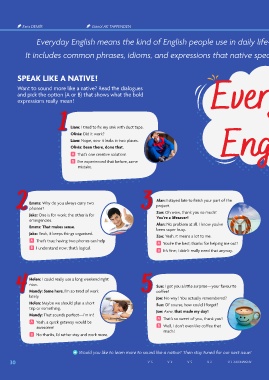
        SPEAK LIKE A NATIVE!

        Want to sound more like a native? Read the dialogues                            Everydayverydayveryday
        and pick the option (A or B) that shows what the bold
        expressions really mean!
                         1 1

                                                                                            Englishnglishnglish
                              Liam: I tried to fix my sink with duct tape.
                              Olivia: Did it work?
                              Liam: Nope, now it leaks in two places.                       E E
                              Olivia: Been there, done that.
                                That’s one creative solution!
                                 I’ve experienced that before, same
                                     mistake.


        2 2  Emma: Why do you always carry two             3 3   Alan: I stayed late to finish your part of the


                                                                 project.
             phones?
                                                                 Zoe: Oh wow, thank you so much!
             Jake: One is for work; the other is for             You’re a lifesaver!
             emergencies.
             Emma: That makes sense.                             Alan: No problem at all. I know you’ve
                                                                 been super busy.
             Jake: Yeah, it keeps things organised.
                                                                 Zoe: Yeah, it means a lot to me.
               That’s true; having two phones can help
                                                                   You’re the best; thanks for helping me out!
                I understand now; that’s logical.
                                                                    It’s fine; I didn’t really need that anyway.

        4 4  Helen: I could really use a long weekend right   5 5  Sue: I got you a little surprise—your favourite


             now.
             Mandy: Same here, I’m so tired of work
             lately.                                             coffee!
                                                                 Joe: No way! You actually remembered?
             Helen: Maybe we should plan a short                 Sue: Of course, how could I forget?
             trip or something.
                                                                 Joe: Aww, that made my day!
             Mandy: That sounds perfect—I’m in!
                                                                   That’s so sweet of you, thank you!
               Yeah, a quick getaway would be
                    awesome!                                        Well, I don’t even like coffee that
                                                                        much!
                No thanks, I’d rather stay and work more.


                               ➡ Would you like to learn more to sound like a native? Then stay tuned for our next issue!
     30                                                         5. A    4. A    3. A    2. B            ANSWER KEY: 1. B

