


Page 38 - Young Wise
P. 38
Arzu ŞENTÜRK YENIÇERI                                                 ACADEMIC CORNER


                                                                              but

                   I Can                                              Can’t
                            nderstand                                  Speak


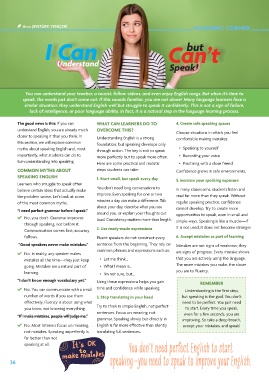
           You can understand your teacher, a tourist, follow videos, and even enjoy English songs. But when it’s time to
          speak, the words just don’t come out. If this sounds familiar, you are not alone! Many language learners face a
           similar situation: they understand English well but struggle to speak it confidently. This is not a sign of failure,
             lack of intelligence, or poor language ability. In fact, it is a natural step in the language learning process.

        The good news is this: If you can   WHAT CAN LEARNERS DO TO      4. Create safe speaking spaces
        understand English, you are already much   OVERCOME THIS?        Choose situations in which you feel
        closer to speaking it than you think. In   Understanding English is a strong   comfortable making mistakes:
        this section, we will explore common   foundation, but speaking develops only
        myths about speaking English and, most   through action. The key is not to speak     •  Speaking to yourself
        importantly, what students can do to   more perfectly but to speak more often.     •  Recording your voice
        turn understanding into speaking.  Here are some practical and realistic     •  Practising with a close friend
        COMMON MYTHS ABOUT               steps students can take:        Confidence grows in safe environments.
        SPEAKING ENGLISH                 1. Start small, but speak every day  5. Increase your speaking exposure
        Learners who struggle to speak often
                                         You don’t need long conversations to
        believe certain ideas that actually make                         In many classrooms, students listen and
                                         improve. Even speaking for one or two
        the problem worse. Let’s look at some                            read far more than they speak. Without
                                         minutes a day can make a difference. Talk
        of the most common myths.                                        regular speaking practice, confidence
                                         about your day, describe what you see
        “I need perfect grammar before I speak.”                         cannot develop. Try to create more
                                         around you, or explain your thoughts out   opportunities to speak, even in small and
            No, you don’t. Grammar improves   loud. Consistency matters more than length.
           through speaking, not before it.                              simple ways. Speaking is like a muscle—if
           Communication comes first; accuracy   2. Use ready-made expressions  it is not used, it does not become stronger.
           follows.                      Fluent speakers do not construct every   6. Accept mistakes as part of learning
         “Good speakers never make mistakes.”                                      sentence from the beginning. They rely on   Mistakes are not signs of weakness; they
                                         common phrases and expressions such as:  are signs of progress. Every mistake shows
            No. In reality, any speaker makes
           mistakes all the time—they just keep     •  Let me think…     that you are actively using the language.
           going. Mistakes are a natural part of     •  What I mean is…  The more mistakes you make, the closer
           learning.                       •  I’m not sure, but…         you are to fluency.
        “I don’t know enough vocabulary yet.”  Using these expressions helps you gain   REMEMBER

            No. You can communicate with a small   time and confidence while speaking.  Understanding is the first step,
           number of words if you use them   3. Stop translating in your head  but speaking is the goal. You don’t
           effectively. Fluency is about using what                         need to be perfect. You just need
           you know, not knowing everything.  Try to think in simple English, not perfect   to start. Every time you speak,
                                         sentences. Focus on meaning, not    even for a few seconds, you are
        “If I make mistakes, people will judge me.”
                                         grammar. Speaking slowly but directly in   improving. So take a deep breath,
            No. Most listeners focus on meaning,   English is far more effective than silently   accept your mistakes, and speak!
           not mistakes. Speaking imperfectly is   translating full sentences.
           far better than not
                                                      You don’t need perfect English to start
           speaking at all.
                                              speaking—you need to speak to improve your English.
     36

