


Page 26 - Young Wise
P. 26
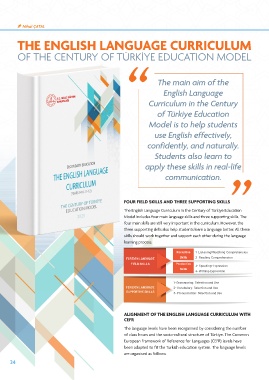
Nihal ÇATAL
THE ENGLISH LANGUAGE CURRICULUM
OF THE CENTURY OF TÜRKİYE EDUCATION MODEL
The main aim of the
English Language
Curriculum in the Century
of Türkiye Education
Model is to help students
use English effectively,
confidently, and naturally.
Students also learn to
apply these skills in real-life
communication.
FOUR FIELD SKILLS AND THREE SUPPORTING SKILLS
The English Language Curriculum in the Century of Türkiye Education
Model includes four main language skills and three supporting skills. The
four main skills are still very important in the curriculum. However, the
three supporting skills also help students learn a language better. All these
skills should work together and support each other during the language
learning process.
Receptive 1- Listening/Watching-Comprehension
FOREIGN LANGUAGE Skills 2- Reading-Comprehension
FIELD SKILLS Productive 3- Speaking-Expression
Skills
4- Writing-Expression
1- Grammaring: Selection and Use
FOREIGN LANGUAGE 2- Vocabulary: Selection and Use
SUPPORTIVE SKILLS 3- Pronunciation: Selection and Use
Unique Thematic
ALIGNMENT OF THE ENGLISH LANGUAGE CURRICULUM WITH
Approach
CEFR
Eight basic topics with
sub-topics at all levels to Standard and Simultaneous
Nationwide Revision
cover almost all
The language levels have been reorganised by considering the number
concepts of life in an Programme
adjacent, interwoven and
of class hours and the socio-cultural structure of Türkiye. The Common
integrated way Standardised and carefully
European Framework of Reference for Languages (CEFR) levels have
designed revision programme
Reduction in the Number for all levels to be
been adapted to fit the Turkish education system. The language levels
of Themes for implemented at the same time
In-depth Learning throughout Türkiye
are organised as follows:
Technological
24 Studying themes in Orientation
depth and using all skills
effectively in the Using technology to
allocation of time THE ENGLISH understand life better,
LANGUAGE to learn deeply, to think
critically, and to
Approach-based CURRICULUM improve life in the most
Learning human way
Socio-Cultural
• Holistic Approach Integration
• Semi-Holistic/Semi-Inductive
Approach
• Inductive Approach Taking into account the
foreign language needs,
cultural background and
Multi-dimensional social contexts of
Assessment and Türkiye along with global
Evaluation awareness and
intercultural
understanding
Emphasis on practice, Post-Method
performance, Pedagogy
competency and
process-oriented Four Field Skills and
assessment and Three Supportive Skills Choosing and using the
evaluation most appropriate
• Listening/Watching-Comprehension techniques and
activities according to
• Reading-Comprehension learners’ diverse
• Speaking-Expression learning needs and
• Writing-Expression characteristics rather
• Grammaring: Selection and Use than a specific and
• Vocabulary: Selection and Use single teaching method
• Pronunciation: Selection and Use

