


Page 27 - Young Wise
P. 27
ACADEMIC CORNER


        SIMULTANEOUS AND COMMON          expressing their own culture in English.  that develop all language skills. In addition,
        REVISION PROGRAMME                                                activities for consolidation, differentiation,
                                         IDIOMATIC EVERYDAY SOCIAL
        The curriculum includes a ‘revision   LANGUAGE EXPRESSIONS        and reflection are included in the themes.
        programme’ at the beginning of each   The English Language Curriculum includes   THE UNIQUE THEMATIC MODEL
        textbook. It helps students review   ‘idiomatic everyday social language   The English Language Curriculum follows
        what they learned before and supports   expressions’ from real-life situations to   a thematic model based on eight
        balanced English learning across Türkiye.
                                         connect classroom learning with everyday   main themes. These themes represent
        CULTURAL AND MORAL               language. These expressions are used   important life concepts for all years and
        FOUNDATIONS                      in every theme and level to make the   levels. Each main theme is divided into
                                         language more current, relevant, fluent,   sub-themes that explain these ideas in
        The English Language Curriculum also
        emphasises the importance of helping   authentic, and meaningful. The ultimate   more detail.

        students recognise their cultural identity   goal is for students to internalise and use   DIFFERENTIATED LEARNING
                                                Receptive
                                                        1- Listening/Watching-Comprehension
        and respect national and moral values. The   the language more naturally.  In differentiated learning, ‘enrichment’ and
                                                        2- Reading-Comprehension
                                                 Skills
                        FOREIGN LANGUAGE
        themes and content are designed in line   REDUCTION IN THE NUMBER OF   ‘supporting’ activities consider students’
                           FIELD SKILLS
                                               Productive
                                                        3- Speaking-Expression
        with students’ cultural backgrounds and   THEMES FOR IN-DEPTH LEARNING
                                                 Skills                   different abilities, learning pace, and
        these values. Therefore, the programme          4- Writing-Expression
                                         The English Language Curriculum has been  needs. These activities help provide fair
        includes activities related to sports, arts,
                                         simplified by considering the number of   and equal learning opportunities for all
                                              1- Grammaring: Selection and Use
        literature, celebrations, ceremonies, and   weekly class hours. Therefore, the number  students. The expected outcomes may
                        FOREIGN LANGUAGE
                                              2- Vocabulary: Selection and Use
        social solidarity. These activities help   of themes has been reduced. The themes   change according to students’ individual
                        SUPPORTIVE SKILLS
        students connect with their national,   3- Pronunciation: Selection and Use
                                         are organised to allow deeper learning   performance.
        cultural, and global environments while
                                         and to provide enough time for activities
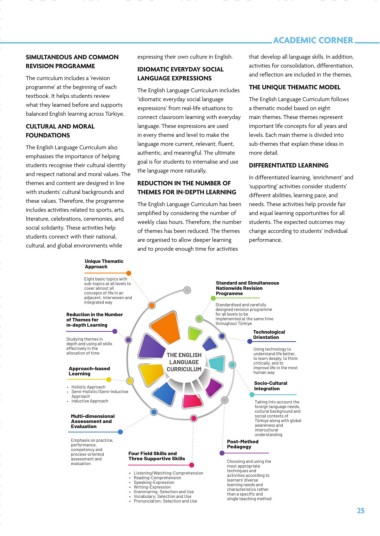
                          Unique Thematic
                          Approach
                         Eight basic topics with
                         sub-topics at all levels to            Standard and Simultaneous
                         cover almost all                       Nationwide Revision
                         concepts of life in an                 Programme
                         adjacent, interwoven and
                         integrated way                         Standardised and carefully
                                                                designed revision programme
                    Reduction in the Number                     for all levels to be
                    of Themes for                               implemented at the same time
                    In-depth Learning                           throughout Türkiye
                                                                           Technological
                    Studying themes in                                     Orientation
                    depth and using all skills
                    effectively in the                                     Using technology to
                    allocation of time           THE ENGLISH               understand life better,
                                                  LANGUAGE                 to learn deeply, to think
                                                                           critically, and to
                     Approach-based               CURRICULUM               improve life in the most
                     Learning                                              human way
                                                                           Socio-Cultural
                    • Holistic Approach                                    Integration
                    • Semi-Holistic/Semi-Inductive
                      Approach
                    • Inductive Approach                                   Taking into account the
                                                                           foreign language needs,
                                                                           cultural background and
                      Multi-dimensional                                    social contexts of
                      Assessment and                                       Türkiye along with global
                      Evaluation                                           awareness and
                                                                           intercultural
                                                                           understanding
                      Emphasis on practice,                        Post-Method
                      performance,                                 Pedagogy
                      competency and
                      process-oriented   Four Field Skills and
                      assessment and   Three Supportive Skills
                      evaluation                                   Choosing and using the
                                                                   most appropriate
                                       • Listening/Watching-Comprehension  techniques and
                                                                   activities according to
                                       • Reading-Comprehension
                                       • Speaking-Expression       learners’ diverse
                                       • Writing-Expression        learning needs and
                                                                   characteristics rather
                                       • Grammaring: Selection and Use  than a specific and
                                       • Vocabulary: Selection and Use  single teaching method
                                       • Pronunciation: Selection and Use
                                                                                                         25

